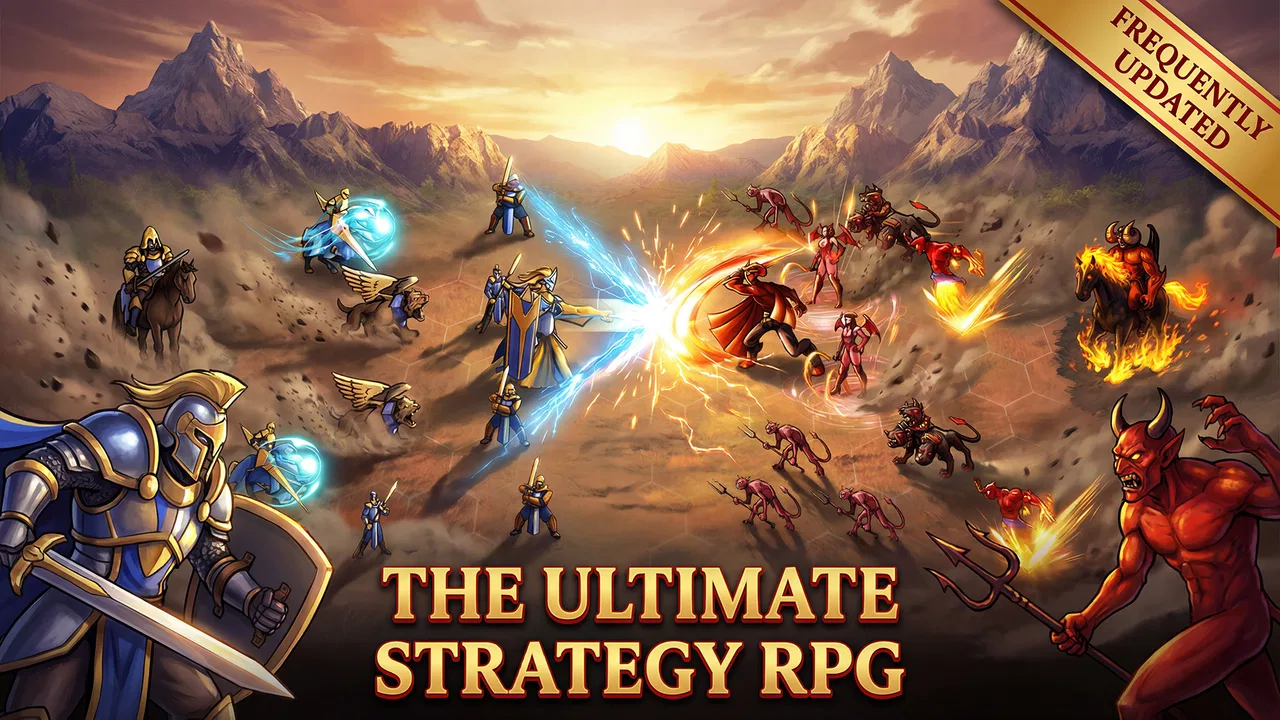
Magic War Legends: Tactics RPG
- 4.2
- Rating
- 5.00M
- Installs
- Free
- Price

 Analysis by App-foxy
I spent time with Magic War Legends: Tactics RPG as a turn-based strategy game and found its appeal fairly easy to understand: it gives you a team of heroes, asks you to think through each move, and keeps the action focused on tactical decisions rather than reflexes. That makes it a comfortable choice for short sessions, especially when I want a game that lets me pause mentally between actions instead of demanding constant attention.
The game comes from TINYSOFT - slots, slot machines & casino games, and it is free to start. It is listed for Everyone, runs on Android 7.0 or later, and has reached over five million installs. Those details make it approachable for a broad audience, although the in-app purchase range, from $0.99 to $399.99 per item, is something I would keep in mind before spending money.
How the tactical pace feels in everyday play
The first thing I noticed is that the turn-based format naturally makes the game feel less stressful than a real-time battle. I can look at the field, consider which hero should act, and decide whether an attack is worth using now or saving for a more important moment. That rhythm is useful when playing during a break, on public transport, or while relaxing at home because the game does not rely on rapid tapping to make every second count.
You May Also Like

 Blood Strike: 2.5 Anniversary
Blood Strike’s Loadouts Turn Every Drop Into a Tactical Gamble
A close look at Blood Strike’s custom loadouts: how fast access to signature weapons reshapes its battle royale rhythm, rewards preparation, and narrows the gap between fights.

 Pandora - Music & Podcasts
Pandora’s Music Is Easy to Start, but Harder to Recover
Pandora’s strength is its low-effort path from a seed to a station. Its weak spot is how much confidence it asks you to place in connection, setup, and quiet recovery.

 8 Ball Pool
 Is Built on Rivalries, Rematches, and Routine
A close look at the rivalries, rematches, shared routines, and unanswered safety questions that turn a quick pool match into a persistent mobile community.

 Samsung Music
’s Quiet Strength Is Playing What You Already Own
Its reach comes less from spectacle than from dependable access to a personal library. That simplicity is both the app’s strongest retention engine and its ceiling.

 AccuWeather: Weather Radar
AccuWeather Review: A Quick, Clear Forecast for Everyday Decisions
For everyday plans, the best forecast is the one you can understand quickly. AccuWeather makes rain timing, radar, and local conditions easy to act on, with a few trade-offs.

 Hill Climb Racing
Why Hill Climb Racing Still Turns Crashes Into One More Run
A tiny car, a bumpy hill and one more upgrade: Hill Climb Racing keeps resurfacing because its simple chaos makes every near-miss feel personal.
More From Our News Desk
View All News


That does not mean every session feels equally quick. A simple encounter can move along at a pleasant pace, while a more demanding fight takes longer because I spend more time comparing possible actions. The perceived speed therefore depends as much on how carefully I play as on the game itself. If I already understand my team, turns feel straightforward. If I am testing a new approach, the same battle becomes slower but more interesting.
I would describe the experience as deliberate rather than sluggish. The tactical structure gives each turn a purpose, and that helps prevent the waiting from feeling empty. Still, players who prefer immediate action may find the pauses between decisions less exciting than the continuous movement of a real-time RPG. This is a game for people who enjoy thinking before committing, not for someone looking for an arcade-style rush.
A useful habit is to enter a battle with a simple plan instead of trying to react to everything at once. I usually identify the most dangerous opponent first, decide which hero is best suited to deal with that threat, and then preserve the remaining options for the next turn. This reduces unnecessary hesitation and makes the overall session feel faster without removing the strategic element.
The hero-focused design also gives the game a different pace from a conventional puzzle or idle title. I am not simply waiting for progress to happen in the background. I need to participate in the outcome, but the turn-based structure gives me enough breathing room to play thoughtfully. That balance is one of the strongest reasons I would recommend it to someone who enjoys strategy but does not want a demanding action game.
Where the game asks for more attention
Longer play sessions reveal a trade-off. At first, choosing actions feels fresh because every decision seems meaningful. After several battles, the repeated decision cycle can become mentally tiring, particularly when I am playing without a clear objective beyond finishing another encounter. The game works best for me in focused bursts rather than as an all-evening activity.
Heavy-use moments are most noticeable when I try to make progress through several battles in one sitting. More encounters mean more menu navigation, more team decisions, and more opportunities to reconsider how I want to use my heroes. Even when the game remains responsive, the mental workload increases. That is not a technical complaint; it is a consequence of a strategy game asking me to stay involved instead of letting the action play itself.
For that reason, I find short sessions more satisfying than marathon runs. A practical routine is to play a few battles, review what worked, and stop before decisions start becoming automatic. This approach also helps me notice which heroes are genuinely useful in my current approach instead of making random changes simply because I have been playing too long.
Another non-obvious trade-off is that a strong-looking move is not always the best move. I get better results when I think about what the next turn will look like rather than celebrating immediate damage. A powerful action may leave another hero exposed, waste a useful ability, or remove flexibility from the following turn. The game rewards restraint, and that can make slower, safer choices more valuable than flashy ones.
Team decisions matter more than tapping quickly
The most useful way I found to approach the hero roster is to judge each character by the job they perform in the team, not just by how impressive an individual attack appears. I think about who can create pressure, who can protect the group, and who helps keep the battle under control. Even without treating every encounter as a puzzle, this role-based view makes team changes more purposeful.
I also recommend changing one part of the team at a time. If I replace several heroes together and the next battle goes badly, I cannot tell which change caused the problem. Testing one adjustment gives clearer feedback and avoids wasting time rebuilding a lineup that was already close to working. This is especially helpful for players who are still learning how the game’s tactical choices fit together.
Resource decisions deserve similar care. Because the game is free to download but includes optional purchases, I would not spend simply because a difficult battle feels frustrating. I prefer to first check whether the problem is poor positioning, a mismatched team, or an ability used too early. That pause is important: in a strategy game, a purchase cannot replace understanding the encounter, and spending under pressure can quickly make the experience less comfortable.
The broad Everyone rating makes the game easy to consider for different age groups, but younger players may still need guidance around optional purchases. The listed price range reaches from small items to purchases of up to $399.99 per item, so I would set device-level purchase protections before handing the game to a child. That is practical advice rather than a criticism of the tactical design.
Stability and recovery between sessions
From a reliability perspective, the most reassuring part of a turn-based format is that it does not punish a momentary distraction in the same way a real-time game can. If I need to look away briefly, I am less likely to lose because I missed a split-second event. That makes the game more forgiving for ordinary use, such as playing while waiting for an appointment or taking a short break during a busy day.
Recovery is also easier when I treat each battle as a separate decision-making exercise. After an unsuccessful attempt, I can think about what went wrong and try a different order of actions instead of feeling forced to maintain a perfect reaction chain. This gives failure some value, because a lost encounter can reveal a weakness in the team or in the way I am spending turns.
At the same time, I would not confuse turn-based pacing with guaranteed technical reliability. Any mobile game can feel different across devices, background activity, and connection conditions, and the confirmed information about this title does not provide performance measurements or hardware benchmarks. My practical advice is to begin with shorter sessions on the device you plan to use, then judge whether the experience remains comfortable when several battles are played consecutively.
The game has been available since December 20, 2018, and its current version is 4.2.5. That gives it a substantial history on mobile, while the version number is a reminder to keep the installation updated when possible. Updating is particularly sensible for a game that you expect to return to regularly, because an older build may not provide the same experience as the current one.
I also like to leave a little room on the device before installing or updating any game, even when the exact storage requirement is not the main focus. A crowded phone can create problems for many apps, and freeing space is a simple first step if installation or updating feels inconvenient. This is not a claim about a specific requirement from the game; it is a sensible part of preparing an older Android device for regular play.
What to expect from device demands
The minimum operating system is Android 7.0, which means the game is not limited to only the newest Android phones. That is useful for players with older compatible hardware, but operating-system support alone does not tell me how smoothly every device will handle longer sessions. A phone can meet the software requirement and still provide a less comfortable experience if it has limited remaining resources or struggles with other apps running in the background.
For an older phone, I would close unnecessary apps before playing and begin with a modest session. If the game feels comfortable during a few battles but becomes less pleasant after extended use, shorter play periods are the sensible adjustment. I would not recommend buying a new device solely for this game without first trying it on the phone already available.
Players using newer phones should still consider battery habits. Turn-based games are often easier to play casually than fast action titles, but a long session can still be demanding simply because the screen remains active. I prefer playing while the phone has a healthy charge and avoiding a long run when I need the device for navigation, calls, or work afterward.
One strength here is that the game’s core appeal does not depend on frantic movement. If performance is not perfect on a modest device, a slower tactical rhythm may remain more tolerable than it would in a competitive action game. That does not eliminate technical discomfort, but it does make the title more forgiving when the phone is not at its best.
Compared with a typical real-time RPG, this is the better option for someone who values control and planning over speed. Compared with a purely idle strategy game, it asks more of me because I need to make meaningful choices rather than simply collect progress. A puzzle game may offer quicker individual rounds, while this title provides more room for building a plan around heroes and turn order. The right choice depends on whether I want tactical involvement or effortless progression.
Who will enjoy it, and who should look elsewhere
I would recommend Magic War Legends: Tactics RPG to players who enjoy team-based strategy, like experimenting with heroes, and prefer battles that leave room for thought. It is also a good fit for someone who wants to play in short intervals without needing the reflexes required by a real-time combat game. The free entry point makes it easy to test that style before deciding whether it deserves a regular place on the phone.
I would be more cautious recommending it to someone who dislikes repeated tactical decisions or wants a story-driven experience with no pressure to consider optional purchases. Players who prefer completely predictable spending may also want to approach carefully because the available in-app items extend from $0.99 to $399.99. In that situation, setting a firm no-spend rule or using purchase controls is more important than chasing faster progress.
It is also not my first choice for a very quick, one-minute distraction. A turn-based battle can be paused mentally, but it still benefits from attention. If I only have a few seconds, a simpler casual game is more convenient. When I have enough time to think through a handful of turns, however, the strategy becomes the point rather than an obstacle.
My overall performance verdict
After weighing the pace, the heavier mental moments, and the practical concerns around older devices, I see this as a comfortably paced strategy game rather than a performance showcase. Its strongest quality is that it makes tactical play approachable: I can slow down, reconsider a move, and learn from a failed attempt. That also makes it more suitable for everyday mobile use than games that demand uninterrupted concentration.
The main limitations are equally clear. Longer sessions can feel repetitive or mentally tiring, and players need to remain aware of optional purchases even though the game is free to start. Device experience may vary, so I would test it on the intended phone instead of assuming that the minimum operating-system requirement guarantees identical smoothness everywhere.
With an average rating of 4.2 from over two hundred thousand ratings and more than two thousand reviews, the game has attracted a substantial audience. Those figures do not decide my opinion on their own, but they fit my impression that the central tactical loop has broad appeal. It is easy to begin, yet it gives patient players reasons to think more carefully about team choices and turn order.
My final advice is to approach it as a thoughtful hero strategy game, not as a fast action title or a completely hands-off idle experience. Start free, learn how your team behaves, change lineups methodically, and avoid spending to solve a problem you have not yet understood. If that style sounds enjoyable, Magic War Legends: Tactics RPG is a worthwhile game to try, particularly for short, deliberate sessions on a compatible Android device.
FAQs for Magic War Legends: Tactics RPG
01What is Magic War Legends: Tactics RPG?
Magic War Legends: Tactics RPG is a fantasy strategy game built around turn-based tactical battles, collectible heroes, magical abilities, and squad management. Players assemble a team of legendary characters, position them carefully on the battlefield, and use each hero’s strengths to defeat opposing forces. Progress generally includes upgrading units, unlocking skills, and completing story or challenge-based content.
02How does the combat system work in Magic War Legends: Tactics RPG?
Battles require more than simply choosing the strongest characters. You normally take turns moving heroes, selecting targets, and activating abilities while considering attack range, terrain, enemy placement, and team roles. Tanks can protect weaker allies, damage dealers can focus on priority targets, and support characters may heal or strengthen the group. Planning each turn is especially important in difficult encounters.
03Is Magic War Legends: Tactics RPG free to download and play?
The game can generally be downloaded without an upfront purchase, but free access may be supported by optional in-app purchases, advertisements, energy systems, or other progression-related mechanics, depending on the platform and version. You can usually enjoy the main gameplay without paying, although purchases may speed up upgrades or provide additional resources. Check the store listing for current pricing and payment details.
04Does the game require an internet connection?
An internet connection may be needed for several important features, including account synchronization, events, rewards, updates, advertisements, purchases, and online competitive modes. Some portions of the campaign may work temporarily offline, but this should not be assumed for every version or device. For the most reliable experience, connect to a stable Wi-Fi or mobile network before launching the game.
05Is Magic War Legends: Tactics RPG suitable for beginners?
The game is approachable for players who are new to tactical RPGs because early battles usually introduce movement, abilities, team building, and upgrades gradually. However, later stages can demand careful planning and resource management. Beginners should avoid upgrading every character at once, learn each hero’s role, and build a balanced team instead of relying only on the highest damage characters.
Pros
- Turn-based battles make it easy to plan attacks and manage your team.
- A broad roster of heroes encourages experimentation with different strategies.
- Short missions fit well into quick gaming sessions on mobile.
- Character upgrades provide clear long-term progression goals.
- Fantasy visuals and effects give battles a lively
- polished feel.
Cons
- Progress can slow noticeably when upgrade materials become scarce.
- Higher stages may rely heavily on team power rather than tactical skill.
- The large number of currencies and resources can feel confusing at first.
- Some rewards and features are tied to daily tasks and repeated battles.
- Online features may be inconvenient for players with limited connectivity.

Magic War Legends: Tactics RPG
Gallery